
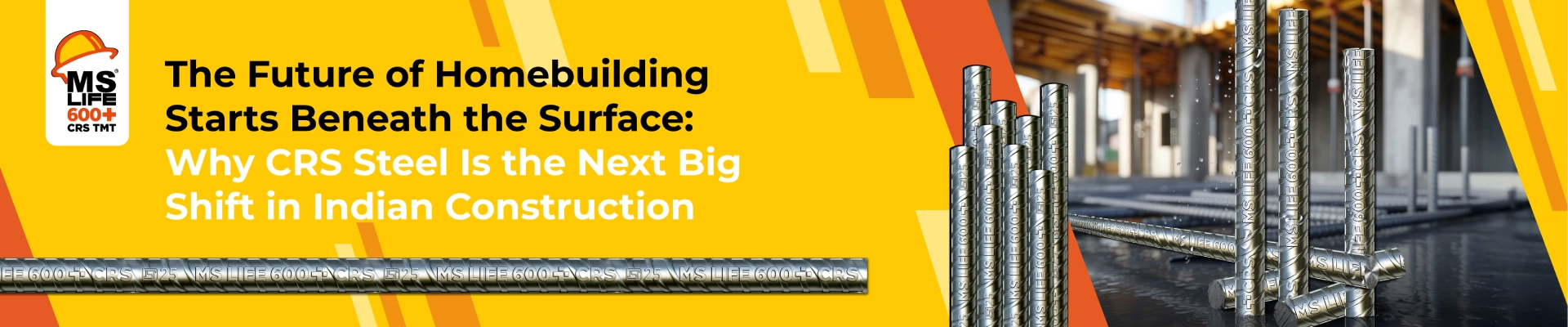
The Future of Homebuilding Starts Beneath the Surface: Why CRS Steel Is the Next Big Shift in Indian Construction
In every home that rises across India—from the bustling localities of Hyderabad to the serene coastlines of Kochi, from the fast-growing suburbs of Bengaluru to the humid plains of Chennai—there lies a hidden truth that rarely gets spoken about: the real future of construction doesn’t begin with architecture, design, or even technology on the surface; it begins deep inside the skeleton of a structure, in the steel that supports the entire weight of human ambition, dreams, and everyday life. For decades, builders, families, and engineers have focused on what they can see—tiles, paints, lighting, furniture, and exteriors—but today, as climate conditions shift, as rainfall patterns change, as humidity continues to rise, as coastal regions battle salinity like never before, and as India’s modern homes aspire to stand stronger and longer than the generations who built them, a new understanding is emerging: the future of homebuilding starts beneath the surface, and that future is CRS steel—Corrosion Resistant Steel—an innovation that is rapidly becoming the backbone of safer, smarter, and more resilient construction across India. And at the forefront of this shift stand MS Life 600+ CRS TMT Bars, which are redefining what durability, safety, and long-term reliability truly mean in Indian construction.
For decades, the construction industry relied on ordinary TMT bars, believing that concrete would shield steel from moisture, corrosion, and environmental damage. But real life has shown otherwise. Across South India, from the monsoon-soaked lanes of Kerala to the salt-heavy breeze of Tamil Nadu’s coastal belt, from the relentless humidity of Karnataka’s coastal districts to the intense seasonal shifts in Telangana, moisture has found its way into concrete again and again. And wherever moisture goes, corrosion follows. Countless families have seen cracks appear in their walls, rust marks emerge on pillars, and structural strength weaken silently from within—all because the steel hidden beneath the concrete was not built to withstand the environmental challenges of a rapidly changing climate. Today, engineers and builders are no longer asking how to decorate a home but how to protect it from the inside, and the answer is becoming increasingly clear: CRS steel is not just the next trend, it is the next necessity.
CRS steel is transforming the foundational thinking of construction because it solves one of the oldest and most persistent problems—corrosion. For decades, corrosion has been quietly compromising Indian structures, often without homeowners ever knowing until the damage becomes visible. Ordinary TMT bars react quickly to moisture, humidity, and salinity. Microscopic rusting begins almost immediately in damp environments. As rust forms, the steel expands, cracking the concrete around it, creating pathways for more moisture to seep in, accelerating damage in a destructive cycle that eventually compromises the entire structure. But CRS (Corrosion Resistant Steel) breaks that cycle at the very beginning. Using advanced metallurgical science, micro-alloying elements like chromium, copper, and nickel, and high-purity primary steel, CRS bars create a protective internal barrier that resists corrosion even in extreme moisture and salinity conditions. It is not a coating—coatings chip away. It is a built-in, intrinsic molecular resistance that protects homes from the inside out.
This shift matters now more than ever because India’s climate reality has changed drastically in the last decade. Monsoons have become more unpredictable, with sudden cloudbursts and extended wet seasons. Coastal regions face increasing salinity damage as sea levels rise and winds carry salt deeper inland. Humidity levels remain high throughout the year in cities like Chennai, Kochi, Mangalore, and even Bengaluru. Waterlogging during heavy rains exposes construction sites to prolonged moisture. Old assumptions—that concrete alone can protect steel, that rusting takes decades, that moisture damage is rare—no longer hold true. Families investing their life savings into homes cannot afford to gamble with materials that aren’t engineered for today’s environmental realities. CRS steel has emerged as the future because it responds not to assumptions, but to actual climate challenges.
MS Life 600+ CRS TMT Bars stand at the heart of this transformation. Built with primary steel, manufactured with German Thermex technology, and engineered specifically for corrosion-heavy climates like South India, they represent a new era in construction—one where steel isn’t just strong, but smart; not just durable, but resilient; not just for today, but for the next 50, 80, or even 100 years. While ordinary steel deteriorates silently, MS Life CRS bars stand the test of time by slowing down corrosion to a fraction of what ordinary TMT bars experience, ensuring that the internal structure remains stable, safe, and untouched even when exposed to moisture day after day.
The future of homebuilding is shifting also because of how people build today. Construction is no longer just about erecting walls and roofs. Families want homes that last. Developers want structures that reduce maintenance costs and long-term repairs. Architects want materials that match their ambitious designs. And today’s construction environment is far more challenging than it once was—homes are built taller, foundations go deeper, and structures must withstand environmental stressors unimaginable to previous generations. CRS steel supports this evolution because it brings longevity into the equation from the very first step.
But the rise of CRS steel is not only about science—it is also deeply personal. Every family building a home dreams not just of comfort but of safety. Parents want walls strong enough to protect their children. Children want homes that carry the warmth and legacy of generations. Homeowners want peace of mind—that the money, effort, and emotion poured into building a home will not be threatened by invisible forces like rust and corrosion. CRS steel offers that peace of mind because it ensures the foundation of the home—the part nobody sees but everyone depends on—is built to survive moisture, weather, and time itself.
In South India, where the battle between moisture and construction materials is constant, the adoption of CRS steel is nothing short of revolutionary. Consider coastal cities like Chennai or Kochi, where salt-laden air corrodes steel twice as fast. Or monsoon-heavy regions like Kerala, where structures remain wet for months. Or even rapidly growing urban centers like Hyderabad, where unpredictable weather and rising humidity affect construction quality. Builders here have seen firsthand the difference between ordinary TMT bars and CRS bars. Ordinary steel begins rusting within years. Structures weaken prematurely. Reinforcement becomes brittle. Repairs become inevitable. But CRS steel significantly slows down this deterioration, ensuring that the home built today remains strong decades later.
This is why MS Life is leading the shift—because it doesn’t just offer CRS steel, it offers reliability rooted in science, backed by purity, and proven in some of India’s most moisture-heavy environments. Their bars bond better with concrete, resist rust more effectively, and maintain their strength even under fluctuating temperatures and periodic wetting. This allows engineers to design safer structures, builders to execute more confidently, and families to trust in the long-term safety of their homes.
The future of homebuilding also demands sustainability, and CRS steel contributes meaningfully to that future. Long-lasting structures reduce the need for frequent repairs, reconstruction, and material wastage. Homes built with corrosion-resistant steel have a smaller carbon footprint over their lifetime because they do not require repeated interventions. Durability becomes a form of environmental responsibility. The longer a building stands strong, the fewer resources it consumes over time.
But beyond science, climate, and sustainability, the future belongs to CRS steel because it transforms homebuilding from reactive to proactive. Instead of responding to corrosion once it appears, CRS steel prevents it from happening in the first place. Instead of waiting for moisture to create damage, CRS steel blocks it at the molecular level. Instead of building homes that require constant monitoring, CRS steel allows families to build once and live with confidence forever.
This is the shift India needs—and the shift that has already begun.
As families across South India choose MS Life CRS bars for their homes, they are not just choosing a material; they are choosing security for their children, stability for their future, and longevity for their memories. They are participating in a movement that values strength beneath the surface as much as beauty on the outside. They are embracing a future where structures survive not just through calm seasons but through storms, humidity, coastal winds, and the unpredictable forces of nature.
This is why the next chapter of Indian construction is being written not on the walls we see, but in the steel we don’t. And in that story, CRS steel stands at the center—reshaping how India builds, how families protect their dreams, and how homes live longer, safer, and stronger than ever before.
Because the future of homebuilding isn’t just about modern design or smart technology—it begins beneath the surface, with MS Life 600+ CRS TMT Bars leading the way as the next big shift in Indian construction.